
Serbia: Students End Vučić’s 14-Year Grip
Serbia's Student List won the 25 October snap election with about 52.7% and 140 of 250 seats on preliminary results; a massacre in Taraba, Nigeria, killed at least 48 to 62 people; and the WEF ranks geoeconomic confrontation as the top global risk for 2026.
Published

In late October 2026, Serbia’s snap parliamentary elections delivered a decisive break with the status quo. The Student List, a movement that grew out of mass protests following the Novi Sad tragedy two years earlier, secured roughly 52.7 percent of the vote and an absolute majority in the 250-seat parliament (projected around 140–141 seats). Aleksandar Vučić’s “United Serbia” list, the vehicle of the Serbian Progressive Party that has dominated since 2012, took about 39 percent and roughly 103–104 seats. Turnout reached nearly 69 percent—the highest in more than a decade.
Vučić conceded on election night. The Student List is not a conventional party; it is a leaderless formation rooted in student and civic mobilization that registered candidates only weeks before the vote. Its victory ends an era of concentrated executive power, media dominance, and allegations of institutional capture. International reactions came quickly from Washington, Brussels, Moscow, and Kyiv, reflecting Serbia’s strategic position between the EU, Russia, and the wider Balkans.
The result does not automatically produce stable governance. Forming and sustaining a government from a protest-born list will test whether street energy can translate into administrative competence and whether the new majority can restrain the security and patronage networks built over 14 years. For independent observers, the election is a rare case in which sustained civic pressure overcame an entrenched ruling apparatus without major violence—something mainstream coverage often treats as background noise until the ballots are counted.
Nigerian Bandit Violence: The Taraba Massacre
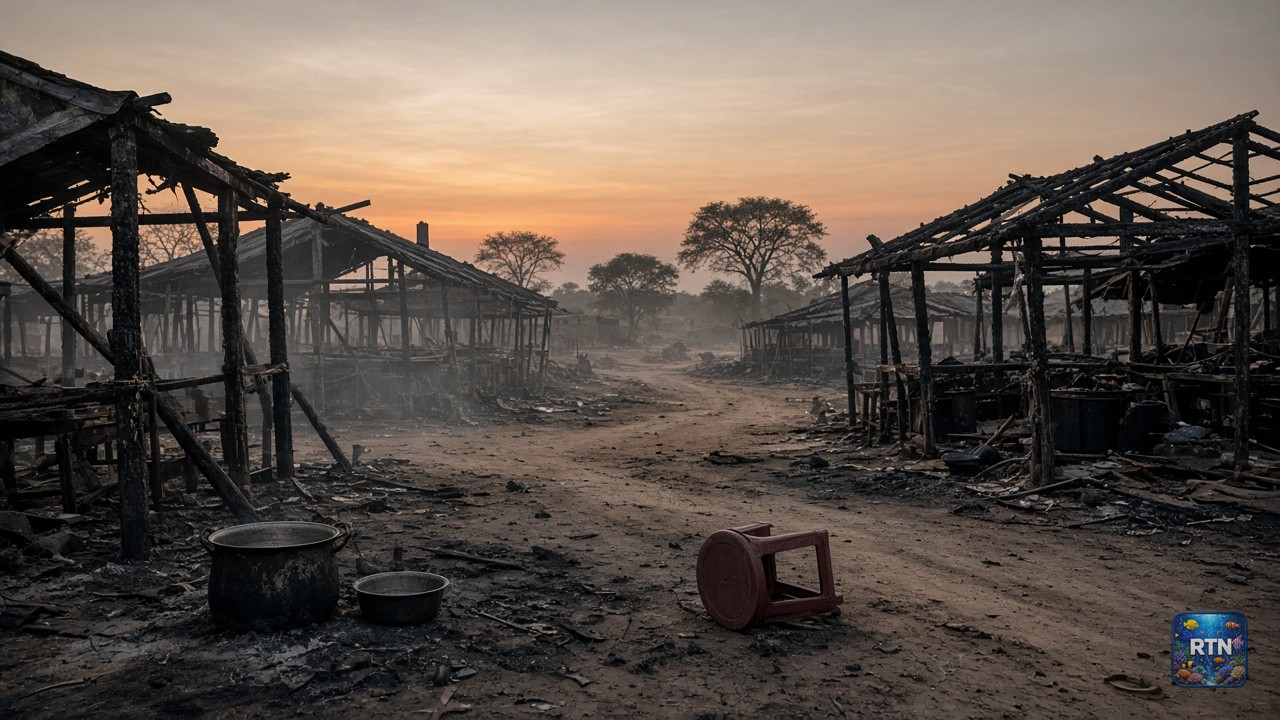
Illustration (AI-generated): burned market stalls at dusk. Not a photograph of Binnari or of any real person.
On Friday, 23–24 October 2026, armed men on motorcycles attacked Binnari village in Karim Lamido local government area of Taraba state. They struck shortly after Friday prayers, firing from multiple directions, setting homes and shops alight, and looting. Initial police figures reported around 10 deaths. As search teams recovered bodies from bushes and the nearby river—where many residents had fled and drowned—the toll climbed rapidly. Amnesty International Nigeria, local residents, and the National Emergency Management Agency later put the confirmed dead in the range of 52 to 62, with dozens more wounded and thousands displaced.
The attackers are described as “bandits,” the term used across northern Nigeria for armed criminal groups that combine kidnapping for ransom, village raids, and control of illegal mining. The violence sits alongside, and sometimes overlaps with, the longer jihadist campaigns of Boko Haram and Islamic State West Africa Province, but much of the current predation is driven by financial motive and local grievance rather than pure ideology. Rural communities remain exposed: poor roads, limited communications, and slow security response allow hours-long attacks before forces arrive. Amnesty has repeatedly criticized authorities for leaving civilians “at the mercy of gunmen that repeatedly commit atrocities with impunity.”
This single massacre is one data point in a chronic security crisis that has killed thousands and displaced far more across Nigeria’s north. International attention is intermittent; the structural drivers—weak state presence, economic desperation, and the profitability of armed predation—receive less sustained scrutiny than higher-profile conflicts.
Broader Structural Issues: Geoeconomic Confrontation, Debt, AI, and Fragmentation
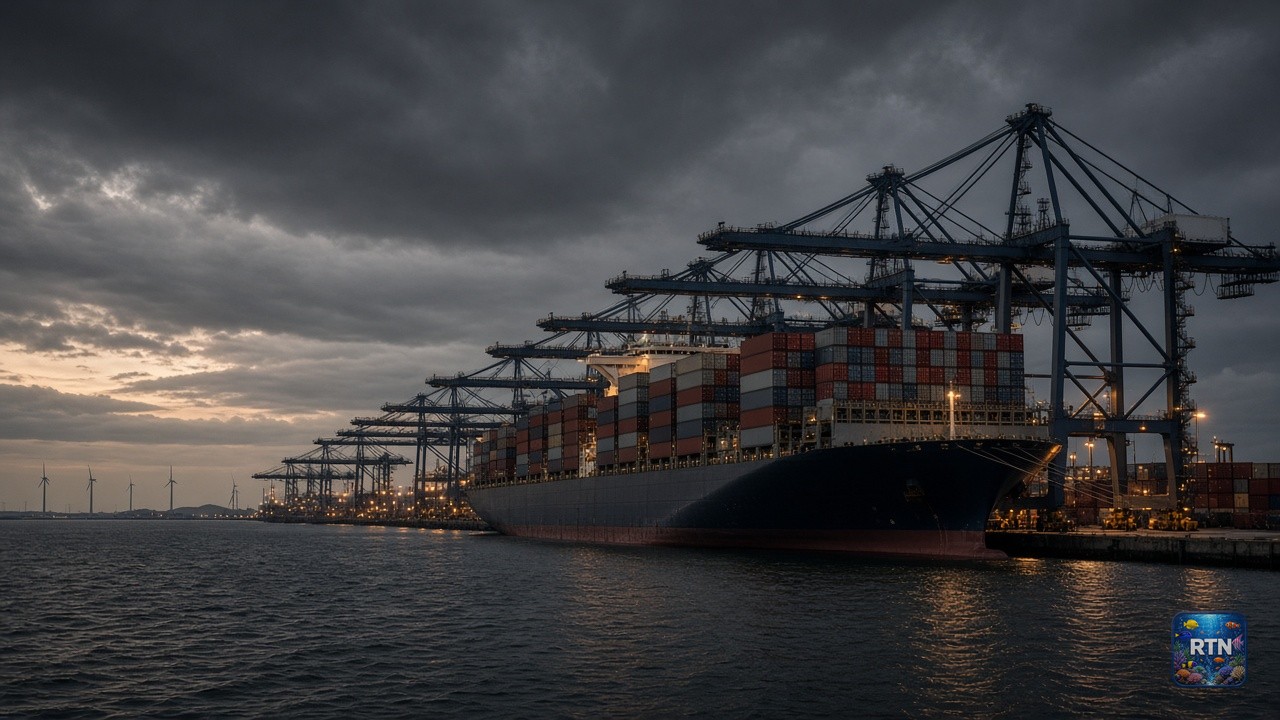
Illustration (AI-generated): a container port at dusk. Not a photograph of any real port.
The World Economic Forum’s Global Risks Report 2026 ranks geoeconomic confrontation as the top near-term risk, followed by state-based armed conflict. Experts surveyed identify the deliberate use of trade restrictions, sanctions, technology controls, investment screening, and supply-chain leverage as instruments of strategic competition. These tools have moved from exceptional to routine. Semiconductor and AI controls, rare-earth export threats, energy market fragmentation, and secondary sanctions have reconfigured trade and investment patterns. Third-country firms in China, India, and elsewhere have filled gaps created by Western-Russian decoupling; European manufacturers have absorbed energy-cost shocks while some U.S. energy and shipping interests have gained. The result is a more selective, politicized global economy in which reliability and political alignment matter as much as price.
Public debt compounds the pressure. Global government debt has risen sharply since the pandemic, energy shocks, and higher defense spending; advanced-economy debt remains above 100 percent of GDP in many cases and is projected to approach or exceed levels last seen after the Second World War. High debt limits fiscal space for infrastructure, education, and resilience just as climate adaptation and technological competition demand investment. An AI-driven equity boom has supported growth forecasts, yet IMF and private analyses note that a moderate correction in AI valuations could erase recent growth upgrades through the sovereign-bank nexus and tighter financial conditions. Data-center energy demand adds an inflationary channel that interacts with ongoing Middle East supply risks.
Multiple active conflicts—Ukraine, residual Middle East flashpoints, Sudan, Ethiopia, Nigeria’s north, and others—interact with these economic trends. Arms flows, energy price volatility, and refugee movements create feedback loops. Misinformation and societal polarization rank high in short-term risk assessments; adverse outcomes of AI technologies rise sharply in longer-term rankings. Environmental risks (extreme weather, ecosystem stress) remain severe on a 10-year horizon even as geopolitical concerns dominate the immediate outlook.
Underreported angles include the distribution of gains and losses from geoeconomic measures (who captures the rents when supply chains are rewired), the quiet erosion of multilateral enforcement capacity, and the incentive structures that reward prolonged conflict or technological protectionism over rapid de-escalation. Independent reporting that tracks primary documents, capital flows, and local outcomes—rather than official narratives—remains essential for mapping these structural shifts. The combination of high debt, weaponized interdependence, technological acceleration, and unresolved armed conflicts defines the operating environment of late 2026 more than any single headline.
Sources
- Preliminary election results from 8,187 polling stations determined, Government of the Republic of Serbia (RIK results). Accessed 28 October 2026.
- Serbia's veteran ruler Vučić concedes election to student-led protest movement, BBC News. Accessed 28 October 2026.
- Vucic concedes defeat to Serbia's student-led movement, Associated Press. Accessed 28 October 2026.
- CRTA Election Observation Mission: preliminary assessment of election day, CRTA. Accessed 28 October 2026.
- Gunmen kill at least 40 people in northeastern Nigeria, Amnesty International says, Reuters via Arab News. Accessed 28 October 2026.
- Death toll in Nigeria village raided by gunmen rises to 48, police say, BBC News. Accessed 28 October 2026.
- At least 62 people killed in criminal gang attack on a community in northeastern Nigeria, Associated Press. Accessed 28 October 2026.
- Global Risks Report 2026: Key findings, World Economic Forum. Accessed 28 October 2026.
Sources link to external sites. Their content is the responsibility of their publishers.
More in Untold World
Untold WorldAnalysis
Melania Trump’s Quiet Breakthrough in a Broken City: The Oleshky Ceasefire and the Human Cost of a Stalled War
Untold WorldNews
Burnham's Brexit "conversation" wobbles as Healey prepares his first Budget
Untold WorldNews