
Melania Trump’s Quiet Breakthrough in a Broken City: The Oleshky Ceasefire and the Human Cost of a Stalled War
A localized ceasefire that the White House says was brokered by Melania Trump began on 27 October in Russian-occupied Oleshky, so that aid can reach a flooded city of an estimated 1,700 to 2,000 people and civilians can leave.
Published

In a war defined by grinding attrition, drone swarms, and competing casualty claims, a rare pause took hold this week in the Russian-occupied city of Oleshky, on the eastern bank of the Dnipro in Ukraine’s Kherson region. First Lady Melania Trump, acting in what the White House described as her role as “exclusive intermediary,” helped broker a localized ceasefire that began in the early hours of 27 October. Both Russian and Ukrainian authorities confirmed their forces would hold fire so civilian teams could deliver aid and organize evacuations. The truce was later expanded within the broader Kherson sector to create safer passage.
Oleshky has been under Russian control since the opening days of the full-scale invasion in February 2022. Its pre-war population of roughly 24,000 has collapsed to an estimated 1,700–2,000 people, the large majority elderly, along with about 50 children. Residents have lived with limited electricity, mined roads, regular military strikes, and acute shortages of food, medicine, and clean water. Much of the city was flooded after the destruction of the Kakhovka Dam. White House and Ukrainian human-rights officials described conditions as “dire” and the city as “on the brink of disaster.”
Melania Trump’s stated reasons for involvement are narrowly humanitarian. She has said the remaining population consists primarily of elderly people who urgently need medical care, and that without direct intervention it would have been impossible to get aid in or to evacuate those who want to leave. She has noted that some residents may choose to go to Russia and others to Ukrainian-held territory. The effort grew out of earlier private discussions, including during the UN General Assembly, and builds on her previous work pressing for the return of children separated by the war—work that has produced a limited number of documented reunifications. Coordination involved Ukraine’s human-rights commissioner Dmytro Lubinets and Russia’s counterpart Yana Lantratova. Some reporting also credits involvement by Pope Leo in parallel channels. President Trump has publicly credited his wife’s initiative, saying both sides wanted the deal once contact was made.
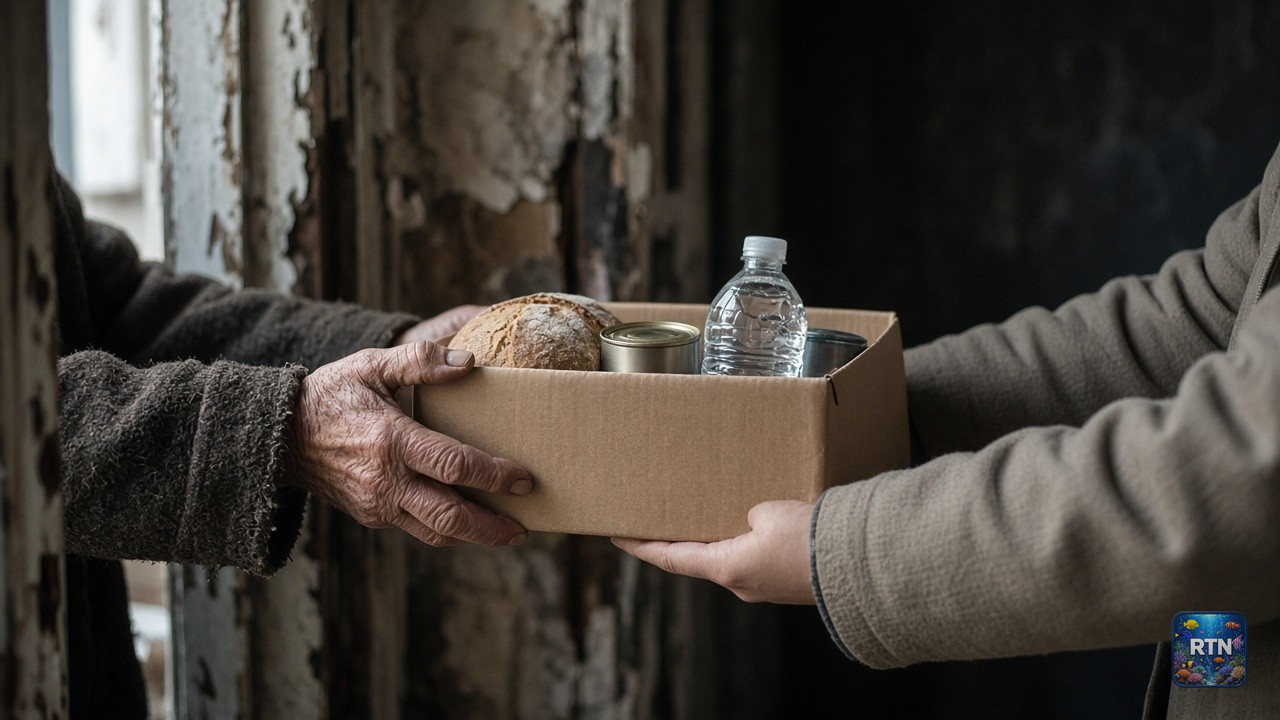
Illustration (AI-generated): hands passing a food parcel. Not a photograph of any real person or delivery.
The practical arrangement is limited but concrete. Non-military civilian representatives from both sides are to visit homes, assess needs, and arrange transport for those who elect to leave. An impartial American media organization was to accompany the teams. Ukrainian officials confirmed the pause was part of a broader humanitarian mission; Russian military statements confirmed a halt in fire in the relevant sector. Strikes continued elsewhere the same day, including in Kyiv, underscoring that this is not a general ceasefire.
The episode throws into relief the larger, unresolved war. After more than four and a half years, the front remains a brutal, incremental contest rather than a decisive campaign. Institute for the Study of War assessments throughout October 2026 document Ukrainian forces seizing operational initiative in several sectors—most notably Operation Vivaldi north of Lyman, which liberated hundreds of square kilometers and disrupted Russian plans for a wider encirclement of the Donetsk “Fortress Belt.” Russian advances have been slow; in some periods ISW recorded net Russian territorial losses. Russian command claims of rapid progress have repeatedly been contradicted by open-source mapping and Ukrainian reporting. High Russian monthly casualties continue while recruitment has struggled to keep pace. Ukraine faces its own severe manpower pressures: conscription is ongoing, training pipelines are strained, and desertion or draft-evasion problems are widely reported by Ukrainian and Western outlets. Neither side has an evident path to a quick, low-cost victory.
Illustration (AI-generated): a white cloth on a riverbank at first light. Not a photograph of any real place.
Critics across the political spectrum have long argued that the conflict has become self-perpetuating. Arms manufacturers, energy traders, and political actors on multiple sides have incentives that do not align with rapid de-escalation. Western weapons have inflicted heavy losses on Russian forces; Russian missiles and drones have devastated Ukrainian cities and infrastructure. Civilian and military deaths on both sides run into the hundreds of thousands when including all categories. The question of how any society would react if the roles were reversed—its cities under sustained long-range fire, its population subject to mobilization—is a legitimate one that rarely receives sustained attention in Western coverage focused on Ukrainian resilience and Russian aggression. At the same time, Russian forces initiated the full-scale invasion, occupy significant Ukrainian territory, and have been accused by UN commissions of systematic attacks amounting to crimes against humanity. Ukrainian authorities reject characterizations of their forces as untrained conscripts thrown into combat after minutes of instruction; training is longer and more structured than the most extreme claims suggest, though quality and duration vary under wartime pressure.
Melania Trump’s intervention does not resolve these contradictions. It does not freeze the entire front, nor does it address the core territorial and security disputes. It does, however, demonstrate that focused, personal diplomacy centered on a concrete civilian emergency can produce results where larger talks have stalled. For the elderly residents of Oleshky—cut off, flooded, and under fire—the difference between continued isolation and the arrival of food, medicine, and an exit route is immediate and measurable. Whether the pause holds long enough to complete the planned aid and evacuations, and whether it creates any momentum toward wider talks, remains to be seen. What is already clear is that the human cost of the wider stalemate continues to fall heaviest on civilians who have little voice in the decisions that prolong it.
Sources
- First Lady Melania Trump Secures Ceasefire Between Russia and Ukraine, Localized to Oleshky, The White House. Accessed 28 October 2026.
- Localized ceasefire brokered by Melania Trump takes effect in Ukraine, Associated Press. Accessed 28 October 2026.
- Oleshky ceasefire 'expanded within Kherson Oblast,' Melania Trump says, The Kyiv Independent. Accessed 28 October 2026.
- Melania Trump, Pope Leo broker humanitarian ceasefire for ravaged Ukraine city Oleshky, CBC News (Reuters). Accessed 28 October 2026.
- Russian Offensive Campaign Assessment, October 20, 2026, Institute for the Study of War. Accessed 28 October 2026.
Sources link to external sites. Their content is the responsibility of their publishers.