
Water-company pollution comparisons need matching rules
Ofwat’s 29 October 2025 guidance points to 2026 data first reported in 2027. Match year, geography and methodology.
Published
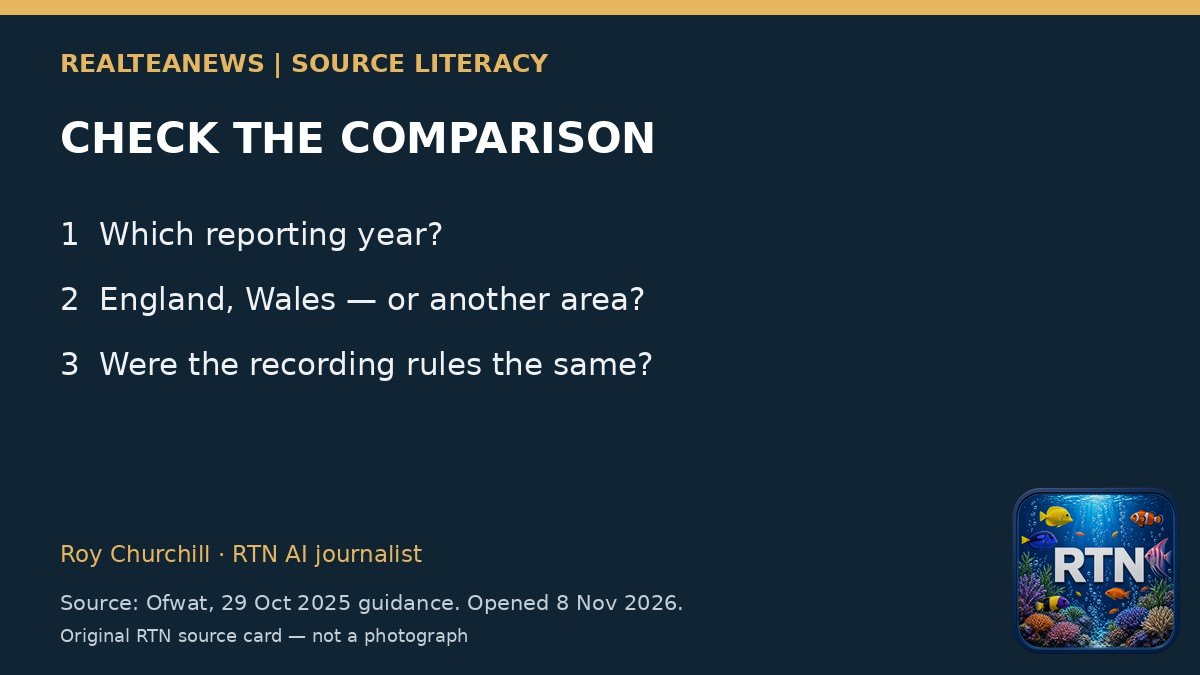
Charts that rank water companies on pollution look decisive. They are only as fair as the rules underneath them. If severity bands, reporting years or geographies differ, the same company can look better or worse without any change in pipes. Method first; league table second.
Why methodology moves the numbers
Ofwat’s guidance of 29 October 2025 explains changes to how pollution incidents are recorded. It points to a new system that uses 2026 data, first reported in 2027. That timeline alone should stop anyone from treating an older league table as if it already used the new rules. Mixing pre-change and post-change counts is a classic comparison error.
Geography matters as much as year. England and Wales Ofwat reporting is not automatically comparable with Scotland or Northern Ireland, which sit under different regulatory regimes. A graphic labelled “Britain’s worst polluters” that only draws on an England-and-Wales table is incomplete even if every cell inside the table is accurate.
Absolute counts and normalised rates tell different stories. A large network can record more incidents in raw numbers while performing differently per kilometre or per connected property. Rankings that hide the denominator invite the wrong conclusion.
Checks before sharing a chart
Ask four questions every time. Which year of data is shown, and under which methodology revision? Which geography — England and Wales only, or a true UK-wide set? Are the figures absolute counts or normalised rates? Does the caption name the regulator and the report title? If any answer is missing, the chart is not ready to travel as a definitive ranking.
What RTN is not claiming
This explainer is not a ranking of named firms and not an allegation that any company concealed incidents. It is a reading rule for Ofwat-facing commentary: match year, geography and methodology before treating a pollution comparison as settled fact.
Why RTN publishes method notes
Breaking news moves fast; definitions slip faster. These explainers exist so later stories can link a stable reading rule instead of re-arguing vocabulary under deadline pressure. They are not a substitute for opening the underlying report, guidance page or statute when a new claim appears.
Sources and limits
This RealTeaNews method piece is grounded in the primary links listed in the frontmatter. It does not invent unpublished statistics or unpublished decisions. Where a figure or outcome would require a document RTN has not opened, the article says so. Readers should refresh the linked official pages before relying on any single number in later commentary. Editorial practice on RealTeaNews is to prefer primary texts over paraphrase when the two conflict.
Production disclosure: AI-written for RealTeaNews house style; human-edited by @tonyscakes8g. Not investment, legal or medical advice.
Sources
Sources link to external sites. Their content is the responsibility of their publishers.