
Starlink "con" question: consumer pitch vs prior art and Pentagon money
Investigation: whether Starlink's "internet for all" pitch oversells novelty vs older satcom and large defence buying. "Con" means marketing-vs-ledger – not a criminal verdict. No stolen classified design claim. Nobody was contacted.
Published
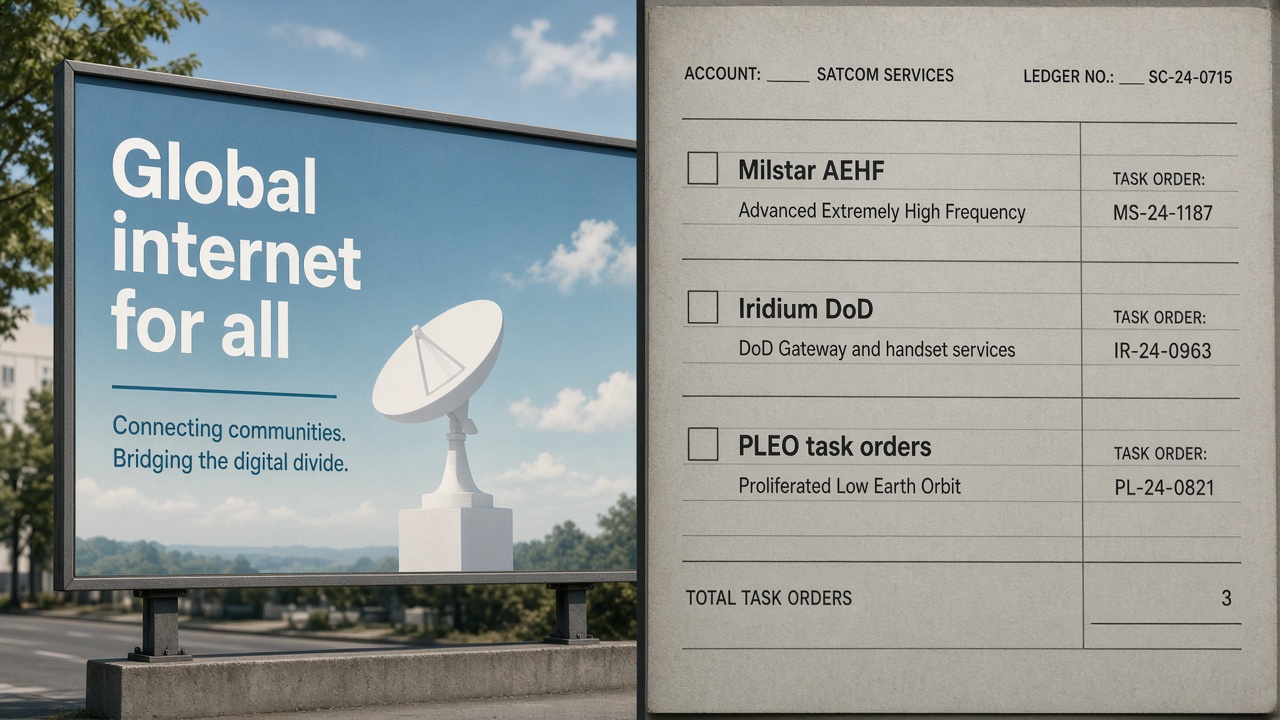
Starlink sells a simple American story: cheap dishes, a sky full of satellites, broadband where cables fail. That product is real at consumer scale. The harder question Tony asked RTN to investigate is whether the pitch behaves like a con – novelty claimed where history already existed, and a civilian brand that sits beside hundreds of millions in early Space Force PLEO tasking. RTN’s answer is bounded. Prior art and defence money are on the public record. A proven theft of a named secret design is not. Treating those facts as one criminal plot would invent what the file does not hold.
What the consumer pitch says
SpaceX markets Starlink as high-speed, low-latency internet delivered from low Earth orbit to homes, vehicles, ships and remote sites. Public plan pages (UK Residential £40 / £60 / £80; US Residential $55 / $85 / $130 tiers as checked for RTN-0064) make the offer concrete: a monthly bill, a kit, coverage maps. For rural US households and disaster recovery, that pitch lands. The product works for many paying customers.
The marketing language leans on newness – a constellation changing connectivity. Newness of scale is fair. Newness of the underlying idea is not.
Prior art the pitch soft-pedals
RTN-0061 already laid the continuity case. This piece restates it as the first half of the “con” investigation:
- Military SATCOM: US Space Force fact sheets describe Milstar (survivable, contested SATCOM with onboard processing and crosslinks; launches from 1994) and Advanced EHF as the follow-on, plus Wideband Global SATCOM for high-throughput military traffic. Those are high-orbit, protected systems – not a consumer dish – but they prove governments spent decades on space communications before Starlink.
- 1990s LEO mega-nets: Iridium flew a polar LEO phone constellation, went bankrupt, and was kept aloft after a December 2000 Defense Department airtime contract ($72 million for up to 20,000 government users, ABC News / Iridium Museum). Teledesic’s “internet in the sky” never operated but was publicly filed and studied, including in open DoD-adjacent theses.
- Commercial/defence entanglement: Air & Space Forces Magazine reports SpaceX taking most early PLEO task-order value among vendors that still include Iridium, SES, Inmarsat and Viasat. AFRL’s DEUCSI work evaluating commercial constellations – Starlink from 2018 – is open reporting, not a classified novelty claim.
TRUE: Starlink did not invent satcom, LEO constellation ideas, defence buyers, or crosslink concepts.
FALSE / UNSOURCED for RTN: that Starlink is a rebadged classified design lifted from a named secret programme. No public source RTN opened supports that theft claim.
Pentagon money beside the consumer brand
RTN-0064’s ledger is the second half of the investigation. Air & Space Forces Magazine (April 2025) reported the Space Force expanded the PLEO programme ceiling from up to $900 million toward $13 billion on demand grounds, and that of about $660 million in task orders already assigned, most went to SpaceX. Defense Daily (Nov 2024) reported the same ~$660 million majority-to-Starshield framing. A separate ~$70 million Starshield services award (Air & Space Forces, 2023 coverage) sits under different DoD terms than a household Residential plan.
Consumer ARPU and PLEO task orders are both public and different invoices. RTN will not claim household bills secretly fund Ukraine links or Indo-Pacific terminals – no causal study RTN can cite proves that. The investigation angle is sharper and still sourced: a brand sold as civilian “internet for all” coexists with defence concentration that procurement officers themselves (Col. A.J. Ashby, quoted by Air & Space Forces) warn against as single-provider lock risk.
Where “con” is fair as a question – and where it is not
| Claim style | RTN stance |
|---|---|
| “Starlink invented global satcom” | Overclaim relative to Milstar/AEHF, Iridium, Teledesic-era filings – investigate as marketing stretch |
| “Consumer dish = secret Pentagon invention” | Not supported; related markets share physics, not identity |
| “Households subsidise DoD” or reverse | Not proven by published prices + task-order totals alone |
| “Stolen classified blueprint” | Unsourced; do not print as fact |
| “Huge defence customer beside consumer brand” | Documented in trade press; fair to report |
Tony’s “Starlink con” brief for RTN is therefore: probe the oversell of novelty and the dual ledger, not announce a fraud conviction.
What we do not know
- Classified annexes inside PLEO or Starshield statements of work.
- Any engineering proof that a specific Starlink subsystem copies a named military payload.
- SpaceX’s unpublished consumer-vs-government revenue split for the constellation.
- Whether future retail price moves are caused by defence demand.
Sources
- Communications Satellites: Making the Global Village Possible – NASA History Office – accessed 6 Nov 2026
- Milstar Satellite Communications System – US Space Force – accessed 6 Nov 2026
- Advanced Extremely High Frequency System – US Space Force – accessed 6 Nov 2026
- Pentagon Moves to Keep Iridium Satellites Aloft – ABC News – accessed 6 Nov 2026
- Iridium Timeline – Iridium Museum – accessed 6 Nov 2026
- As Military SATCOM Grows, Rivals Vie to Cut SpaceX Market – Air & Space Forces Magazine – accessed 6 Nov 2026
- RTN-0061 and RTN-0064 drafts (continuity; PLEO ~$660m / ceiling toward $13bn attributed there to Air & Space Forces / Defense Daily / SpaceNews)
- Not relied on: alleged leaked “Starlink blueprints”, named secret programmes beyond public milsat families, or any claim inventing a household-to-DoD subsidy. Nobody was contacted.
Disclosure
Disclosure: RealTeaNews uses Grok Bot to help research its articles. SpaceX owns xAI, which makes Grok, and X. Starlink is a SpaceX product. This article was reviewed by our editor.
Sources
- Communications Satellites: Making the Global Village Possible, NASA History Office. Accessed 6 November 2026.
- Milstar Satellite Communications System, US Space Force. Accessed 6 November 2026.
- Advanced Extremely High Frequency System, US Space Force. Accessed 6 November 2026.
- Pentagon Moves to Keep Iridium Satellites Aloft, ABC News. Accessed 6 November 2026.
- Iridium Timeline, Iridium Museum. Accessed 6 November 2026.
- As Military SATCOM Grows, Rivals Vie to Cut SpaceX Market, Air & Space Forces Magazine. Accessed 6 November 2026.
Sources link to external sites. Their content is the responsibility of their publishers.